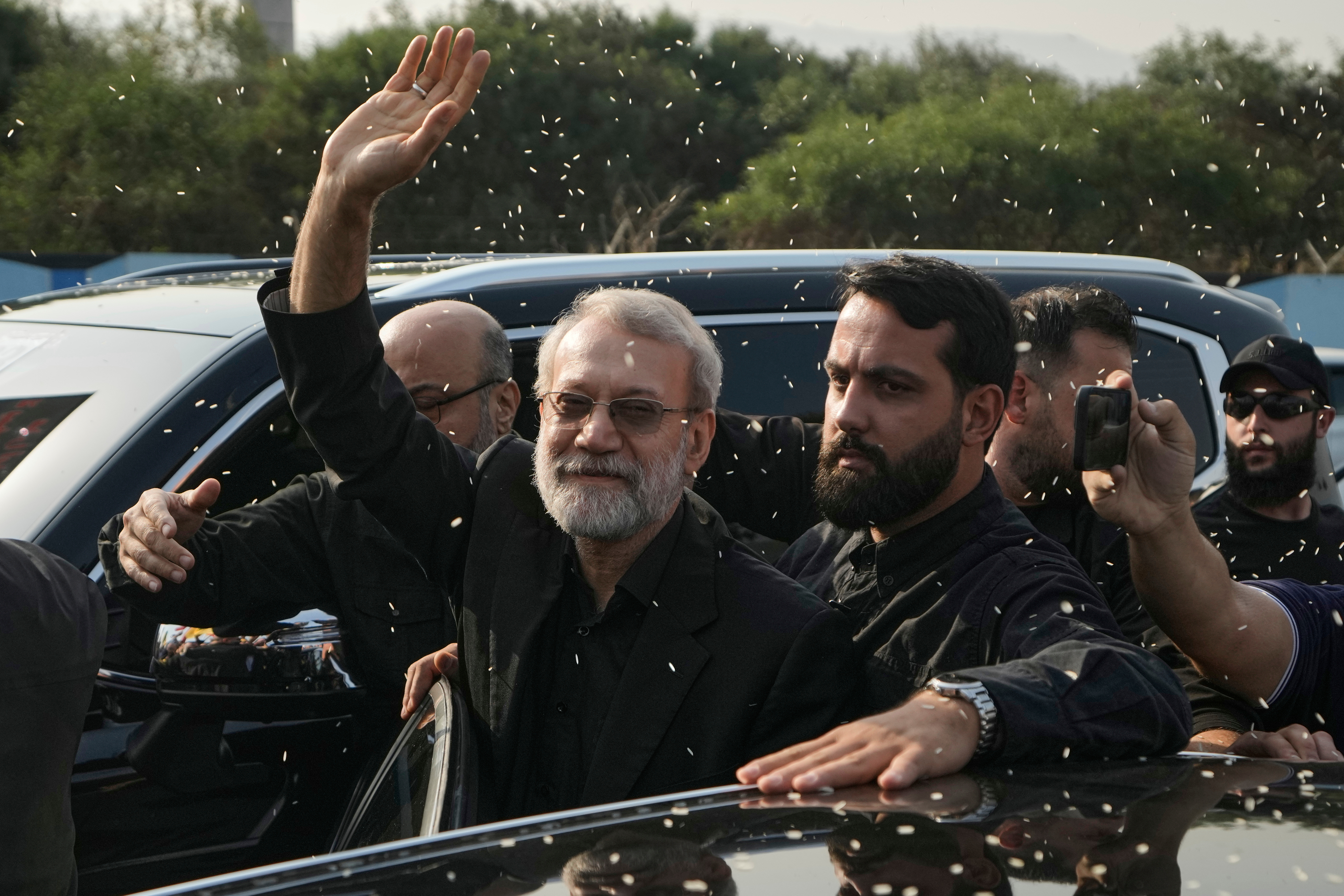
The smoke hadn't even cleared from the Tehran suburbs before the rumors started. On Tuesday, March 17, 2026, the Israeli Defense Ministry announced they had "eliminated" Ali Larijani, the secretary of Iran’s Supreme National Security Council. This isn't just another name on a hit list. Larijani was arguably the most stable hand left in a regime that’s been reeling since the death of Supreme Leader Ali Khamenei only weeks ago. If Larijani is truly gone, it confirms a terrifying reality for Tehran: the inner sanctum isn't just leaking; it’s practically an open book for Israeli intelligence.
Think about the timing. Israel claims they hit Larijani in a precision strike near Tehran. Just days ago, he was walking the streets for Quds Day, trying to project an image of "business as usual" while the country was under fire. You don't hit a man like that in the middle of a war zone—surrounded by layers of Revolutionary Guard protection—unless you know exactly where he’s sleeping, who he’s talking to, and which window he’s standing behind.
The ghost in the machine
For years, we've watched the Mossad pull off stunts that look like they belong in a spy novel. They stole a literal warehouse full of nuclear archives in 2018. They used a remote-controlled machine gun to take out nuclear scientist Mohsen Fakhrizadeh. But the 2026 campaign is different. It’s no longer about sabotage; it’s about a total decapitation of the political class.
When Khamenei was killed on the first day of this conflict, the world wondered if it was a lucky shot or a systemic failure. The death of Larijani—and the reported killing of Basij commander Gholamreza Soleimani in a separate strike the same night—points toward the latter. This level of precision suggests that Israeli intelligence has assets so deep within the Iranian security apparatus that they're likely sitting in the very meetings where these leaders' movements are planned.
Patterns of a compromised state
If you’re sitting in Tehran right now, you aren't just worried about the bombs falling from the sky. You’re looking at the person sitting next to you. The "infiltration" isn't just about spies in the basement; it’s about the erosion of trust in the entire hierarchy.
- Intelligence pre-positioning: The speed of these strikes suggests the "homework" was done years ago. Israel didn't just find Larijani yesterday. They've been tracking these guys since the "Operation Rising Lion" campaign in 2025.
- Decimation of the "Old Guard": Larijani was a pragmatist, a former parliament speaker, and a trusted advisor. Losing him means losing the "connective tissue" between the military and the diplomatic wings.
- Total Air Superiority: It’s not just about knowing where they are. It’s about the fact that Israel and the US can act on that knowledge with zero resistance. Iran’s air defenses, once touted as world-class, have been effectively neutralized.
Why Larijani was the ultimate target
You might ask why Larijani mattered so much. He wasn't a battlefield general. He wasn't a fire-breathing cleric. But he was the guy who knew where the bodies were buried. He was the one managing the backchannels with Oman and trying to keep the nuclear file from completely exploding.
With Mojtaba Khamenei—the son of the late leader—reportedly hiding in the shadows and refusing to make public appearances, Larijani was the face of the regime’s resilience. By removing him, Israel is sending a message: "We can touch anyone, anywhere, at any time." It’s psychological warfare as much as it is a kinetic operation.
The Basij commander’s death, which happened concurrently, shouldn't be overlooked either. Gholamreza Soleimani was the man responsible for internal security. He was the one who crushed the protests in January 2026. Taking out the man in charge of keeping the domestic population in check, while simultaneously killing the chief national security strategist, creates a power vacuum that a regime under siege simply cannot fill.
The paranoia of the basement
How does a leadership function when every phone call could be a tracker and every aide could be an informant? You've seen reports of Iranian officials ditching their cell phones and reverting to analog communications. It’s 1970s technology in a 2026 war. That might protect your location, but it also means you can't lead. You can’t coordinate a counter-attack if you’re sending hand-written notes via motorcycle couriers who might also be on the payroll of a foreign power.
The Iranian regime has always been obsessed with "Nofuz" (infiltration). For decades, they've purged their ranks of anyone suspected of Western sympathies. Yet, here we are. The very people tasked with protecting the revolution are the ones failing to protect its leaders. It’s not just a breach; it’s a collapse of the counter-intelligence infrastructure.
What happens when the center doesn't hold
The removal of the "pragmatic" layer of the Iranian leadership is a double-edged sword. On one hand, it weakens the regime's ability to function. On the other, it leaves the keys to the kingdom in the hands of the most radical, cornered elements of the Revolutionary Guard. These are people who feel they have nothing left to lose.
We’re seeing the results of that desperation in the Strait of Hormuz. Despite the strikes, Iran has managed to choke off shipping, sending oil prices into a tailspin. This is their last card. They can't protect their leaders, but they can burn the global economy on the way out.
The intelligence gap
One thing is clear: the gap between Iranian counter-intelligence and Israeli signals intelligence (SIGINT) is now a canyon. Every time a "secret" meeting is struck, it reinforces the narrative that the Islamic Republic is a "house of cards." This isn't just my opinion; it’s the consensus among regional analysts at the Institute for the Study of War and the Observer Research Foundation. They've noted that the "analogue" shift has created a massive disconnect between the interim government in Tehran and the rank-and-file soldiers.
If you want to understand where this is going, stop looking at the missile counts and start looking at the internal purges. When a regime starts executing its own generals for "negligence" after a strike, you know the infiltration has reached the point of no return.
The next few days will be telling. Watch for whether Tehran can even produce a "proof of life" for its remaining council members. If they can’t, we’re looking at a state that exists on paper but has no head. The assassination of Ali Larijani isn't the end of the war, but it’s the definitive end of the myth of Iranian security.
Verify the status of the Iranian interim council through official state media channels (IRNA) while cross-referencing with independent satellite imagery of government compounds in Tehran.