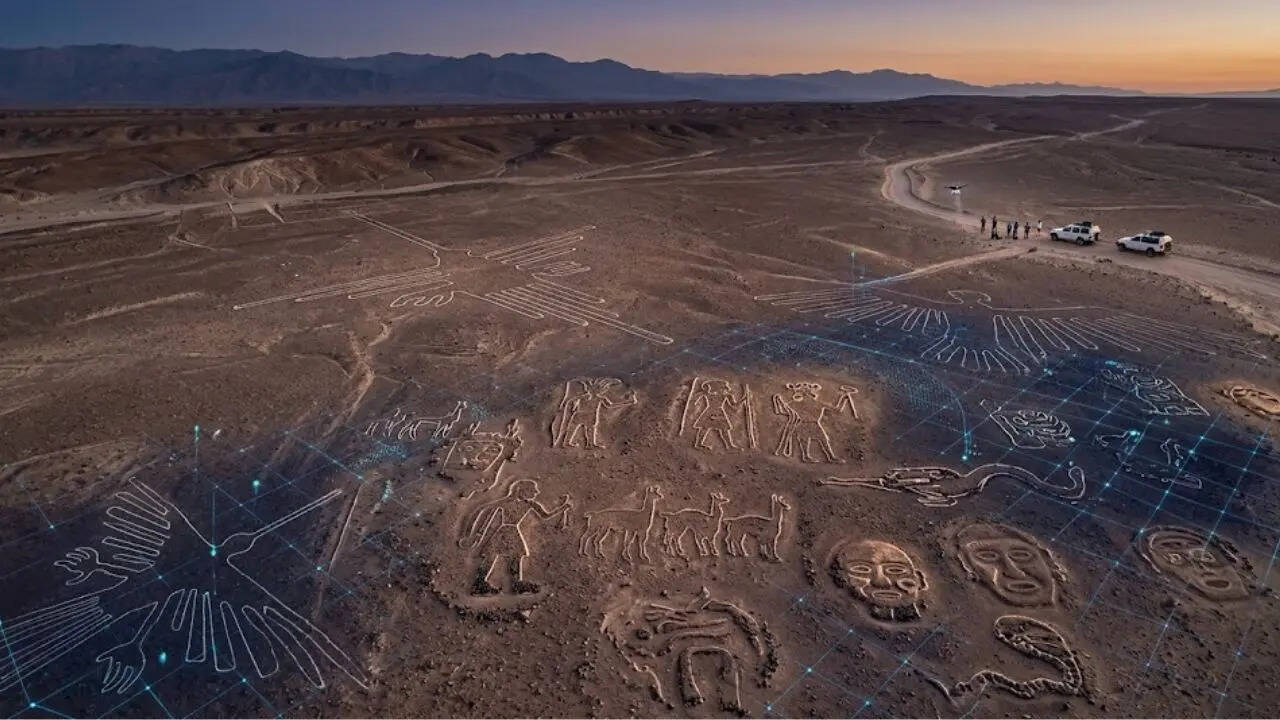
The tech sector is currently congratulating itself over a headline that sounds like a sci-fi triumph: researchers deployed machine learning models and drone imagery to discover 303 previously unseen geoglyphs in Peru’s Nazca Desert in a matter of months.
The mainstream press swallowed the narrative whole. They painted a picture of a dormant field suddenly electrified by automation, suggesting that algorithms have solved a mystery that baffled humans for a century.
They are wrong.
This is a classic case of confusing data collection with actual discovery. Finding 303 low-contrast relief geoglyphs is a textbook feat of pattern matching. It is not an archaeological breakthrough. By hyper-focusing on the sheer volume of "shapes" spat out by a neural network, the tech-archaeology pipeline is actually blinding us to what these lines mean, how the Nazca people lived, and why our current obsession with automated discovery is a massive diversion of resources.
We are funding the digital equivalent of counting grains of sand while ignoring the beach.
The Flawed Premise of the "AI Explorer"
The lazy consensus says that human eyes are too slow, too biased, and too limited to map the Nazca Desert effectively. The narrative claims that by training a convolutional neural network (CNN) on high-resolution satellite imagery and LiDAR scans, we can eliminate human error and accelerate discovery by a factor of decades.
Here is the mechanical reality of how that study actually functioned. Researchers fed the AI training data consisting of the known, massive "line-type" geoglyphs (the famous spiders, monkeys, and hummingbirds) and the smaller, faint "relief-type" geoglyphs often etched into hillsides. The AI then scanned the desert, flagging anomalies that matched those geometric profiles.
That is not exploration. That is advanced filtering.
When you look at the actual data, the AI did not look at a patch of empty dirt and deduce a human presence. It flagged thousands of potential candidates. Human beings—archaeologists who have spent decades walking the actual dirt of the Sechura Desert—then had to spend thousands of grueling hours verifying those flags on the ground.
If a system flags 10,000 anomalies and a human expert has to manually vet every single one to find 303 real targets, the machine did not replace the archaeologist. It just gave them an incredibly noisy, exhausting to-do list. The bottle-neck was never finding potential shapes; it was verifying them.
The Tyranny of the Relief Geoglyph
To understand why this "mass discovery" is misleading, you have to understand the difference between the two types of Nazca lines.
The giant, linear geoglyphs—the ones that stretch across flat pampas for kilometers—were designed for communal, ceremonial use. They are easily visible from surrounding ridges and high points, contrary to the persistent myth that you can only see them from an airplane.
The 303 shapes found by the AI are almost exclusively small, relief-type geoglyphs. They depict human figures, decapitated heads, and domestic animals, typically carved onto hillsides along ancient trail networks.
Here is the truth nobody in the tech space wants to admit: we already knew these hillsides were covered in small relief carvings. Archaeologists like Giuseppe Orefici and Johnny Isla have documented them for a generation. Finding 303 more of them does not change our statistical understanding of Nazca culture. It merely confirms what we already knew: ancient peoples doodled along trade routes.
Imagine an AI scanning the margins of medieval manuscripts and proudly announcing it found 303 new marginal illustrations of snails fighting knights. Yes, the data set is larger. No, our understanding of the Middle Ages has not shifted by a millimeter.
The High Cost of Digital Beachcombing
I have seen academic departments and tech firms pour millions of dollars into these high-tech scanning initiatives. It looks incredible in a grant proposal. It generates beautiful, high-contrast vector maps that look great in a slideshow.
But it sucks funding away from the real work.
Archaeology is not the study of shapes; it is the study of human behavior through material culture. An algorithm can tell you that a series of rocks forms an outline that resembles a llama. It cannot tell you:
- The chemical composition of the soil beneath those rocks, which reveals whether the site was used for ritual libations.
- The micro-stratigraphy of the desert pavement, which tells us exactly what year the stones were moved.
- The proximity to ancient puquios (the sophisticated underground aqueduct systems that actually allowed the Nazca to survive in the driest desert on Earth).
By prioritizing the automated collection of superficial shapes, we are treating the Nazca Desert like a giant scratch-off lottery ticket. We are scratching off the silver coating at lightning speed, celebrating the numbers we find, but refusing to read the rules of the game printed on the back.
Dismantling the Automated Archaeology Mythology
Let's address the questions that inevitably pop up when people defend this tech-first approach.
Doesn't speed matter when sites are being destroyed by urban sprawl and mining?
This is the most common justification used by tech evangelists. They argue that we need AI to map everything before squatter settlements, agricultural expansion, or illegal mining erase the lines forever.
It sounds noble. It is fundamentally wrong-headed.
A digital map does not stop a bulldozer. Knowing the precise GPS coordinates of an unverified relief geoglyph does nothing to protect it if the local government lacks the budget, political will, or legal framework to enforce conservation zones. If you have half a million dollars to spend on Nazca preservation, throwing it at a tech consortium to generate 300 more dots on a map is a luxury. Spending it on physical fencing, community education, and local ranger patrols actually saves the heritage.
We are prioritizing the creation of a digital morgue over actual life support.
If the AI can find things human eyes miss, isn't that inherently valuable?
Only if the machine is finding things that alter our historical models.
The AI models used in Peru are trained on existing human classifications. They are structurally incapable of finding something entirely novel. If the Nazca people left behind a type of cultural modification that does not fit the geometric parameters of the training data, the algorithm will quietly ignore it forever.
Human eyes are biased, yes. But human bias includes the capacity for serendipity. An experienced archaeologist walking a ridge line might notice a strange alignment of broken pottery shards, a subtle shift in soil texture, or a pile of ancient llama dung that tells a story of an ancient caravan stop. The AI ignores all of that because it is only looking for lines that contrast with the background matrix.
The tech approach turns archaeology into a game of "Where's Waldo?" when it should be a forensic investigation.
The Blind Spot of the Tech-Industrial Complex
The downside to this contrarian view is obvious: manual field survey is slow, hot, expensive, and deeply unsexy. It does not get featured in technology keynotes. It does not allow software engineers to claim they are "democratizing history."
But the reality of the Nazca lines is that they are not a puzzle to be solved by computational power. They were a living part of a hyper-engineered landscape. The Nazca people did not carve these lines to be viewed by gods, aliens, or satellites. They carved them as part of a complex, centuries-long dialogue with a changing climate, using the lines as pathways for water rituals and social cohesion during intense droughts.
When we reduce their culture to a data-labeling exercise—where the ultimate goal is to get a high confidence score from a neural network—we are practicing a new form of cultural reductionism. We are stripping the human element out of the past in order to showcase the power of our modern machines.
The 303 new geoglyphs are not a triumph of AI. They are a monument to our current obsession with quantity over depth. We have more data than ever before, and less idea of what to do with it.
Stop looking at the sky, dreaming of better algorithms to find more lines. Get down in the dirt, look at the water systems, and try to understand how a civilization actually survived in a desert without a single computer.