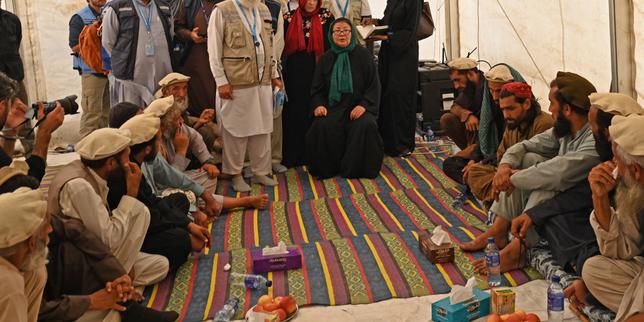
The United Nations mission in Afghanistan is currently trapped in a cycle of diminishing returns that threatens to bankrupt its remaining moral authority. While the organization continues to channel billions in aid and maintain a diplomatic footprint in Kabul, the gap between its mandate and the reality of Taliban rule has become an unbridgeable chasm. It is no longer a question of whether the mission is struggling, but whether its very existence provides a convenient shield for a regime that systematically dismantles the human rights the UN is sworn to protect.
Since the 2021 takeover, the United Nations Assistance Mission in Afghanistan (UNAMA) has operated under the illusion that "principled engagement" would eventually yield concessions from the Kandahar-based leadership. It has not. Instead, the Taliban have mastered the art of pocketing humanitarian aid while tightening the noose on female education, employment, and basic movement. The UN finds itself in a strategic vice. Pull out, and millions face starvation. Stay, and become a permanent witness to—and unwitting financier of—a gender-segregated autocracy.
The Humanitarian Hostage Situation
The core of the current crisis lies in the weaponization of hunger. Afghanistan’s economy collapsed almost overnight after the fall of the republic, leaving a staggering percentage of the population dependent on international shipments of wheat and medical supplies. The UN remains the primary conduit for this lifeline.
However, the Taliban authorities have recognized that the international community’s fear of a mass famine is their greatest leverage. By imposing increasingly restrictive edicts—most notably the ban on Afghan women working for NGOs and the UN itself—the regime is testing the breaking point of international patience. They are betting that the UN will never actually leave.
This creates a perverse incentive structure. The UN spends massive amounts of capital—both financial and political—just to maintain the status quo. We see a pattern where the UN negotiates for months just to allow women to work in a single sector, like healthcare, while the regime simultaneously bans them from every other facet of public life. It is a losing game of incrementalism.
Money Laundering by Another Name
A significant, often under-reported friction point is the physical transport of cash into the country. Because the Afghan banking system remains largely cut off from global markets due to sanctions, the UN must fly in plane-loads of US dollars to fund its operations.
- Physical Cash Influx: Roughly $40 million to $80 million is flown into Kabul every few weeks.
- The Beneficiaries: While this money is intended for aid workers and local procurement, it inevitably stabilizes the local currency, the Afghani.
- Regime Survival: By stabilizing the currency, the UN indirectly helps the Taliban manage inflation and prevent the kind of total economic meltdown that usually topples unpopular regimes.
The UN maintains that this money is tracked and kept in private banks, never reaching the Taliban’s hands directly. This is a technical truth that ignores broader economic realities. You cannot inject billions of dollars into a closed economy without the governing power deriving a massive fiscal benefit. The Taliban don't need to steal the cash; they just need it to circulate.
The Gender Apartheid Dilemma
The UN Charter is built on the foundation of universal human rights. Yet, in Afghanistan, the organization is operating in an environment that is the direct antithesis of these values. This isn't just a "cultural difference" or a temporary setback. It is a deliberate, structural erasure of half the population.
When the Taliban banned women from working for the UN in April 2023, the organization faced a moment of truth. Many expected a full suspension of operations. Instead, after a brief period of "review," the UN continued its work using "creative workarounds." These workarounds often involve men doing the work previously done by women, or women working from home in a diminished capacity.
This pragmatism has a dark side. By continuing to operate under these constraints, the UN is normalizing a state of gender apartheid. It sends a message to other extremist groups globally that the international community’s red lines are actually pink, and highly negotiable.
The Internal Staffing Crisis
The morale within UNAMA and various UN agencies like UNICEF and the World Food Programme (WFP) is at an all-time low. International staff are confined to heavily fortified compounds, while local staff—particularly women—live in a state of constant fear.
Local Afghan employees often feel betrayed. They are the ones on the front lines, facing interrogation by the Ministry for the Promotion of Virtue and the Prevention of Vice, while the UN leadership in New York issues toothless statements of "deep concern." There is a growing sense that the UN is prioritizing its own institutional survival and the continuity of its massive "fat" contracts over the safety and dignity of its local workforce.
Diplomatic Isolation and the Shadow of Recognition
The Taliban crave international recognition. They want their seat at the General Assembly, and they want their diplomats accepted in foreign capitals. The UN mission is the only thing standing between them and total pariah status, yet it also acts as the primary gatekeeper they have to bully to get what they want.
We are seeing a shift in how regional powers—China, Russia, Iran, and Pakistan—interact with the Taliban. These nations are moving toward a de facto recognition, signing mining deals and reopening embassies. They view the UN’s focus on human rights as a Western preoccupation that interferes with regional stability and resource extraction.
If the UN continues to lose influence, the mission will become little more than a glorified delivery service. The political arm of UNAMA, intended to broker "inclusive governance," is essentially talking to a brick wall. The Taliban’s supreme leader, Hibatullah Akhundzada, has shown zero interest in power-sharing or compromise. He views the UN’s presence as a necessary evil for the sake of the economy, but one that must be purged of any "liberal" influence.
The Risk of a Sudden Exit
What happens if the UN finally decides the cost—moral or physical—is too high? An abrupt withdrawal would be catastrophic.
- Immediate Famine: The logistics of food distribution would collapse within weeks.
- Total Information Blackout: The UN is one of the few organizations still able to monitor and report on human rights abuses in remote provinces.
- Regional Instability: A total collapse could trigger a massive new wave of refugees toward Europe and neighboring states.
This is the "too big to fail" trap. The UN has become so essential to the survival of the Afghan people that it can no longer effectively challenge the regime that oppresses them. It is a hostage to its own humanitarian mandate.
Redefining the Mandate
The current path is unsustainable. To regain any semblance of authority, the United Nations must move beyond the "aid for concessions" model that has clearly failed. This requires a shift in strategy that the bureaucracy in New York is notoriously slow to adopt.
Instead of broad, sweeping aid packages that are easily co-opted by the regime, the UN needs to pivot toward highly localized, underground support systems. This means shifting resources away from massive Kabul-based operations and toward decentralized networks that the Taliban find harder to monitor and tax.
Furthermore, the "All-or-Nothing" approach to female employment must be backed by actual consequences. If women are banned from a specific aid program, that program must be shut down immediately, without exceptions or "workarounds." Yes, this will cause short-term pain. But the alternative is the long-term legitimization of a system that treats women as sub-human.
The UN must also stop treating the Taliban as a monolith. While the leadership in Kandahar is hardline, there are pragmatic elements within the Kabul ministries who are terrified of the country’s total isolation. The UN’s diplomatic efforts should focus on widening these internal fractures rather than pretending that a single "national dialogue" is possible.
The Accountability Gap
There is no mechanism for holding the UN accountable for its failures in Afghanistan. The organization "monitors" itself. The periodic reports to the Security Council are often sanitized to avoid offending the member states or the de facto authorities in Kabul.
We need an independent audit of where the aid money actually goes. How much is lost to the Taliban’s "taxes" on transport? How much goes to landlords who are Taliban officials? How many of the "local partners" are actually fronts for the regime? Without this transparency, the international community is flying blind, and the UN is essentially asking for a blank check to continue a failing mission.
The tragedy of Afghanistan is that the UN is doing the right thing for the wrong reasons, and the wrong thing for the right reasons. It provides food to the hungry, which is undeniably good. But in doing so, it provides a safety net for a regime that creates the very hunger the UN is trying to solve. This circular logic is the hallmark of a mission that has lost its way.
The United Nations was never meant to be a permanent governing body or a perpetual food bank for a rogue state. Its presence in Afghanistan is currently a symptom of a broader international paralysis. Until the Security Council can agree on a strategy that moves beyond mere "containment," the UN will remain a paralyzed giant, feeding the victims of a regime it is powerless to change. The choice is no longer between staying or leaving, but between staying as a silent partner in oppression or leaving with a shred of integrity intact.