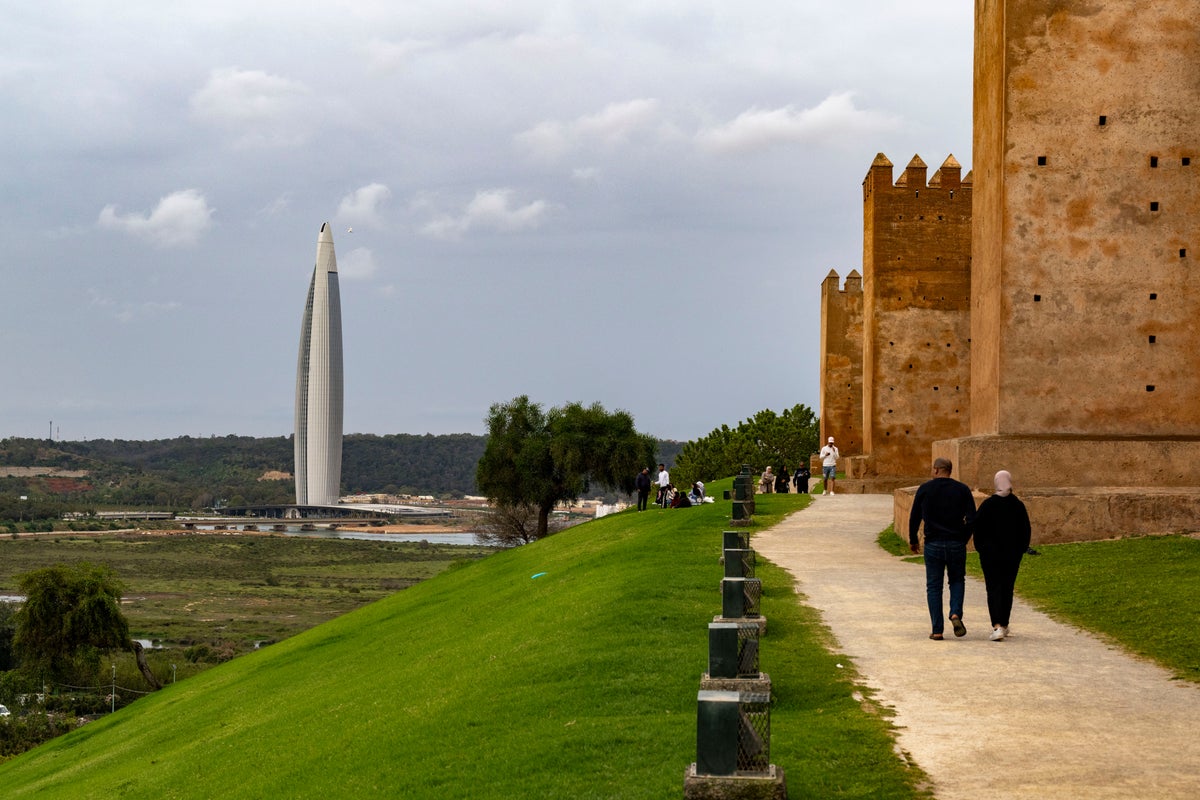
Morocco just finished a massive glass rocket ship. It cost $700 million. It stands 250 meters tall. It's the Mohammed VI Tower, and it’s now the tallest building in Africa. You might think building a skyscraper shaped like a NASA launch vehicle in the middle of a global shift toward remote work is a strange move. It isn't. This isn't just about real estate or office space. It's about ego, geopolitics, and a kingdom trying to prove it's the gateway to an entire continent.
The tower sits in the Bouregreg Valley between Rabat and Salé. It's visible from miles away. It looks like it’s ready to ignite its boosters and head for the moon. But the real destination is economic dominance. Morocco is tired of being seen as just a tourist spot for cheap rugs and spicy tagines. They want to be the financial hub that connects Europe to Sub-Saharan Africa. If you want to be taken seriously as a global player, you build big. You build high. You build things that make people look up.
Why the rocket design is more than a gimmick
The architects didn't just pick a rocket shape because it looked cool on a napkin. Rafael de la-Hoz and Hakim Benjelloun designed this thing to be a literal landmark of progress. It’s meant to symbolize the "Enlightened Morocco." The tower features a high-performance glazing system that covers 33,500 square meters. It’s wrapped in 4,700 square meters of solar panels. That’s a lot of tech for a building.
The structure uses a central core of reinforced concrete and a steel "outrigger" system. It has to handle the wind and the seismic activity in the region. Think about the engineering required to keep a 55-story glass needle from swaying too much in Atlantic gusts. It's a technical marvel. The tower houses a luxury hotel, high-end offices, and apartments that most people will never be able to afford. But the building itself is the message. It tells the world that Morocco has the cash and the engineering talent to pull off something this complex.
The financial gamble behind the glass and steel
Let’s talk about the money. $700 million is a staggering amount for a single building in a developing economy. The project was led by O Towers, part of the FinanceCom Group owned by Othman Benjelloun. He’s one of the richest men in Africa. He’s also a man with a vision that bridges the gap between old-world Moroccan banking and the future of global finance.
Critics argue that this money could have gone into schools or hospitals. It's a fair point. But the Moroccan government sees this as an "anchor project." When a country builds a skyscraper of this scale, it often triggers a halo effect. It attracts foreign direct investment. It convinces multinational corporations that Rabat is a stable, modern city where they should set up their regional headquarters.
I’ve seen this play out in Dubai and Singapore. You build the icon first. The business follows. Morocco is betting that the Mohammed VI Tower will do for Rabat what the Burj Khalifa did for Dubai. It’s a branding exercise on a national scale.
Breaking the height records
Before this, the Carlton Centre in Johannesburg held the title of Africa's tallest building for decades. Then the Leonardo in Sandton took over. Now, Morocco has snatched the crown. This matters because of the "Tallest Building" syndrome. It's a signal of shifting economic power. For a long time, South Africa was the undisputed king of African business. That’s changing. Morocco is positioning itself as the more stable, more connected alternative.
The tower is part of a larger plan called "Rabat City of Light." This includes the Grand Theatre of Rabat, designed by the late Zaha Hadid. It’s a massive cultural and economic overhaul of the capital. They aren't just building a tower; they're building an entire ecosystem for the elite.
Sustainability in the desert heat
You’d think a glass tower in Morocco would be an environmental nightmare. It isn't. The designers went for LEED Gold and HQE certifications. They used 4,700 square meters of photovoltaic panels on the south façade. These panels generate a significant chunk of the building’s energy.
The tower also features a rainwater recovery system. In a country that faces regular droughts, water management is a big deal. They use the recycled water for irrigation and internal systems. It’s a smart move. It shows that even a massive monument to wealth can be somewhat responsible. They used sustainable materials throughout the interior, which was a requirement from the start.
The geopolitical angle nobody is talking about
Look at a map. Morocco is the closest African point to Europe. By building this tower, they're visually asserting their role as the bridge between the two continents. King Mohammed VI has been pushing for years to rejoin the African Union and expand Moroccan influence south of the Sahara.
Moroccan banks, telcos, and insurance companies are already all over West Africa. The tower is the physical headquarters of that expansion. It’s a lighthouse for African capital. When a CEO from Lagos or Abidjan flies into Rabat and sees that rocket-shaped spire, they see a partner that’s playing in the big leagues.
It’s also about competition with Algeria. The two neighbors have been in a cold war for decades. Algeria has the oil, but Morocco has the infrastructure and the vision. The tower is a loud, $700 million statement in that rivalry. It says, "We are the future of the Maghreb."
What this means for the average Moroccan
Most people in Rabat won't ever set foot inside the tower. The luxury apartments are for the ultra-wealthy. The offices are for global firms. But the project created thousands of jobs during construction. It’s also expected to boost tourism. People travel to see architectural wonders.
The real benefit is the infrastructure around it. The development of the Bouregreg Valley has led to better roads, new bridges, and improved public spaces. It’s a top-down approach to urban renewal. Some people hate it. They see it as a vanity project. Others see it as a necessary step for a country that wants to escape the "developing nation" label.
How to see it for yourself
If you're heading to Morocco, you can't miss it. It’s a short train ride from Casablanca to Rabat. The tower is easily accessible from the city center. While the upper floors might be restricted to residents and hotel guests, the surrounding area is designed to be a public hub.
Check out the Grand Theatre nearby while you're there. The two buildings together represent the most ambitious architectural pair in Africa. It’s a glimpse into what a modern, wealthy African city looks like. Don't just look at the height. Look at the details in the glass and the way it reflects the Atlantic light. It's genuinely impressive.
Morocco isn't just building a skyscraper. It’s building a new identity. Whether the $700 million price tag pays off in the long run remains to be seen, but you can't deny the ambition. The rocket has landed in Rabat. It's time to see if it actually takes the economy to the stars.
Go see it before the area gets too crowded. The surrounding valley is still being developed, so you can get a good look at the scale of the transformation right now. Pack a camera with a wide-angle lens. You'll need it to fit the whole thing in the frame.