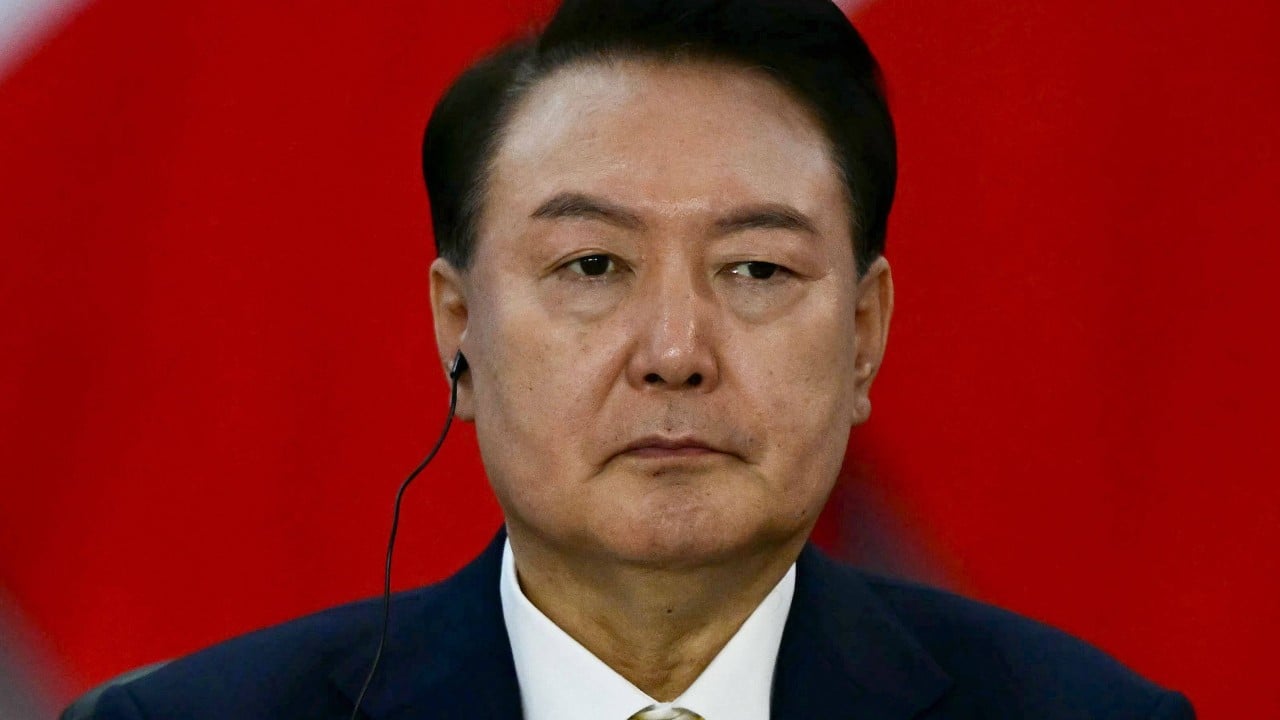
South Korean courts just handed down a 30-year prison sentence to former President Yoon Suk Yeol for his alleged involvement in a covert drone operation over Pyongyang. The international press is running the same predictable script. They are calling it a triumph of constitutional accountability, a definitive victory for the rule of law, and a harsh lesson in democratic boundaries.
They are completely misreading the room.
This verdict is not the triumph of a robust democracy. It is a desperate act of political theater designed to mask a terrifying reality: South Korea’s legal system is being used to retroactively criminalize standard, high-stakes brinkmanship in an era where automated warfare has outpaced international law. By treating a highly classified, strategic military operation as a common domestic conspiracy, Seoul has just signaled to the world that its command structure is fundamentally broken, highly politicized, and incapable of managing modern asymmetric conflicts.
The media wants you to believe this is South Korea’s Watergate. In reality, it is a chilling precedent that ensures no future South Korean leader will have the nerve to make the split-second, high-risk decisions required to counter a nuclear-armed neighbor.
The Illusion of Judicial Independence in Seoul
The mainstream narrative rests on a lazy consensus: that the judiciary acted entirely independent of political winds to punish an overreaching executive. This narrative ignores the cyclical, highly retributive nature of South Korean politics.
Every single living former South Korean president has ended up investigated, arrested, or imprisoned after leaving office. It is a predictable tribal ritual. When the political pendulum swings, the incoming administration routinely weaponizes the prosecution to devour the previous establishment.
To view the 30-year sentence through a purely legal lens is naive. This trial was a political tribunal wrapped in the robes of constitutional law. The court's assertion that Yoon acted entirely outside his constitutional mandate during the drone incident ignores the murky, gray-zone reality of inter-Korean relations. Under Article 66 of the South Korean Constitution, the president is explicitly charged with defending the independence, territorial integrity, and continuity of the state.
When North Korea repeatedly violates South Korean airspace with its own unmanned aerial vehicles (UAVs)—as it did extensively throughout late 2022 and 2023—the line between a defensive counter-operation and an illegal provocation becomes razor-thin. The court pretended this line was clear. It never has been.
The Technological Illiteracy of the Verdict
The legal arguments used to convict Yoon reveal a dangerous lack of technical and military literacy regarding modern drone warfare. The prosecution argued that deploying stealth surveillance drones over Pyongyang constituted an unauthorized act of war that placed the civilian population at catastrophic risk.
This is an archaic view of sovereignty and military engagement.
We are no longer living in an era where cross-border operations require columns of tanks or manned fighter jets. Low-observable, autonomous, and semi-autonomous UAVs are now standard tools for intelligence, surveillance, and reconnaissance (ISR). They are utilized precisely because they offer a non-escalatory alternative to kinetic warfare. They allow states to gather critical intelligence and project deterrence without triggering full-scale mobilization.
Consider the baseline mechanics of the operation in question:
- Asymmetric Deterrence: North Korea regularly tests missiles and sends trash-filled balloons and surveillance drones across the DMZ to map Seoul’s air defenses.
- The Proportionality Principle: Sending unarmed, high-altitude reconnaissance drones to photograph military installations in Pyongyang is a proportional, non-lethal response designed to signal capabilities, not to initiate a conflict.
- Plausible Deniability: Gray-zone warfare relies entirely on ambiguity. By publicly prosecuting the executive branch for a classified operation, the South Korean legal system has stripped the state of its most valuable strategic asset: deniability.
By criminalizing this specific flavor of technological statecraft, the court has effectively signaled to North Korea that Seoul's legal framework will actively assist them in neutering South Korea's asymmetric options. Kim Jong Un does not have to worry about South Korean tech-driven deterrence anymore; he just has to wait for the Seoul Central District Court to indict whoever authorizes it.
The Real Damage to the Chain of Command
I have spent years analyzing East Asian security frameworks and watching defense ministries try to coordinate with civilian oversight committees. I have seen billions of dollars in defense procurement and strategic planning stall out because bureaucrats are terrified of legal liability. What happened to Yoon will paralyze the South Korean military apparatus for a generation.
Imagine being a general officer or a defense minister in Seoul right now. You are tracking an ambiguous aerial threat moving south across the Northern Limit Line. You have minutes to deploy a counter-measure—perhaps an autonomous electronic warfare drone or a stealth interceptor. But you now know that if the political winds shift in the next election, your signature on that operational order could land you in a cell next to an ex-president for the rest of your natural life.
The court has effectively injected extreme legal risk into immediate tactical decision-making.
[Traditional Chain of Command]
President -> Minister of National Defense -> Joint Chiefs of Staff -> Operational Units (Swift Execution)

[The New Post-Verdict Reality]
President -> Constitutional Lawyers -> Judicial Review -> Fear of Future Prosecution -> Operational Paralysis
This is not how you survive when you share a border with a volatile, nuclear-armed dictatorship. The court's decision forces a dangerous hesitation into the South Korean chain of command. In a crisis scenario where hypersonic missiles or swarm drones are airborne, hesitation equals decapitation.
Dismantling the Public Myths
The public discourse surrounding this trial is filled with deeply flawed assumptions. Let us look at the questions people are asking, and rip apart the premises behind them.
Did Yoon’s actions violate the 1953 Armistice Agreement?
The conventional wisdom says yes, because sending drones across the DMZ violates the cessation of hostilities. But this question completely ignores decades of historical reality. The Armistice Agreement has been a dead letter in practice for years. North Korea has violated it thousands of times through commando raids, artillery bombardments of South Korean islands, the sinking of the ROKS Cheonan, and continuous cyber attacks against civilian infrastructure. To hold South Korea to the pristine, literal text of a 1953 agreement while its adversary uses every tool of modern hybrid warfare is a form of strategic suicide.
Shouldn't the National Assembly have exclusive power over acts of war?
Of course legislative oversight matters in a democracy. But requiring a public, parliamentary debate before executing a covert, deniable drone reconnaissance mission is absurd. If a state must announce its covert intelligence operations to a deeply polarized parliament before execution, it can no longer run covert operations. The premise that a stealth drone flight is an "act of war" requiring legislative approval completely misunderstands modern gray-zone conflict. It is espionage and signal projection, not an invasion.
Will this verdict restore South Korea’s international reputation?
The global elite might applaud the spectacle of a country locking up its former leader as a sign of transparency. But inside the Pentagon, and within the intelligence agencies of Tokyo and Canberra, the reaction is pure anxiety. South Korea’s allies rely on a predictable, decisive leadership structure in Seoul. This verdict proves that South Korea’s foreign policy and national security decisions are entirely hostage to volatile domestic political vendettas. It makes Seoul an unreliable partner in any long-term, covert intelligence-sharing framework.
The Cost of Prioritizing Political Purity
There is an obvious downside to the contrarian reality I am laying out. If you accept that the president should have the unchecked authority to launch covert drone operations into enemy territory without fear of future domestic prosecution, you accept a massive concentration of power in the executive branch. You accept the risk of a reckless leader genuinely provoking a conflict through poor judgment.
That is a legitimate, terrifying risk.
But it is a risk that is fundamentally baked into the architecture of any state facing an existential threat. You can choose a system of absolute legal purity, where every single military action is scrutinized by hostile opposition prosecutors and second-guessed by judges years after the fact. If you choose that route, you get a clean conscience, empty prisons, and a totally paralyzed defense apparatus.
Or, you can choose to recognize that the presidency is inherently an office of tragic choices. It requires individuals to operate in the gray zones of international law to protect the state from adversaries who do not play by any rules at all.
South Korea chose political purity. It chose to punish a leader for treating an authoritarian threat with the aggressive, technological asymmetry it deserved.
By locking up Yoon for 30 years over a drone plot, South Korea did not save its democracy. It weaponized its courts to cripple its own defense strategy, handing Pyongyang its easiest strategic victory in decades without North Korea firing a single shot. Future presidents will look at Yoon's cell, look at the radar screens tracking incoming threats from the north, and choose to do absolutely nothing.