Imagine trying to focus on a tactical drill when your home country is actively exchanging missile strikes with the nation hosting your tournament. That is the reality for the Iranian national football team right now. For the first time in modern sports history, a World Cup host nation is in an active military conflict with a qualified participant. The United States and Iran are locked in a dangerous geopolitical standoff following devastating airstrikes in February, yet Team Melli is still expected to show up, lace up their boots, and play beautiful football on American soil.
The sporting world loves to pretend that politics and athletics don't mix. It's a nice fantasy. But the illusion has completely shattered for Iran's players as they finalize their preparations for the 2026 World Cup under conditions that feel less like a sports camp and more like a diplomatic crisis. Also making headlines recently: Atletico Madrid Pursues Cristian Romero Amid Tottenham Hotspur Contract Reality.
The Logistics of Preparing Under Fire
The actual preparation for this tournament has been an administrative and psychological nightmare. Originally, Iran planned to set up its training base at the Kino Sports Complex in Tucson, Arizona. It made sense on paper—18 months of planning went into securing a quiet, high-quality facility to get the squad ready. That plan is dead.
Due to the conflict, security concerns, and severe diplomatic friction regarding visa processing, FIFA had to scramble. United States Secretary of State Marco Rubio publicly noted that Washington would not block athletes, but drew a hard line against allowing any coaching staff or delegates with suspected ties to the Islamic Revolutionary Guard Corps (IRGC) into the country. Further details into this topic are explored by FOX Sports.
The result? FIFA moved Iran’s entire base camp across the border to Tijuana, Mexico. The Mexican government, led by President Claudia Sheinbaum, stepped in to host the squad after the U.S. proved too logistically and politically hostile for a prolonged stay.
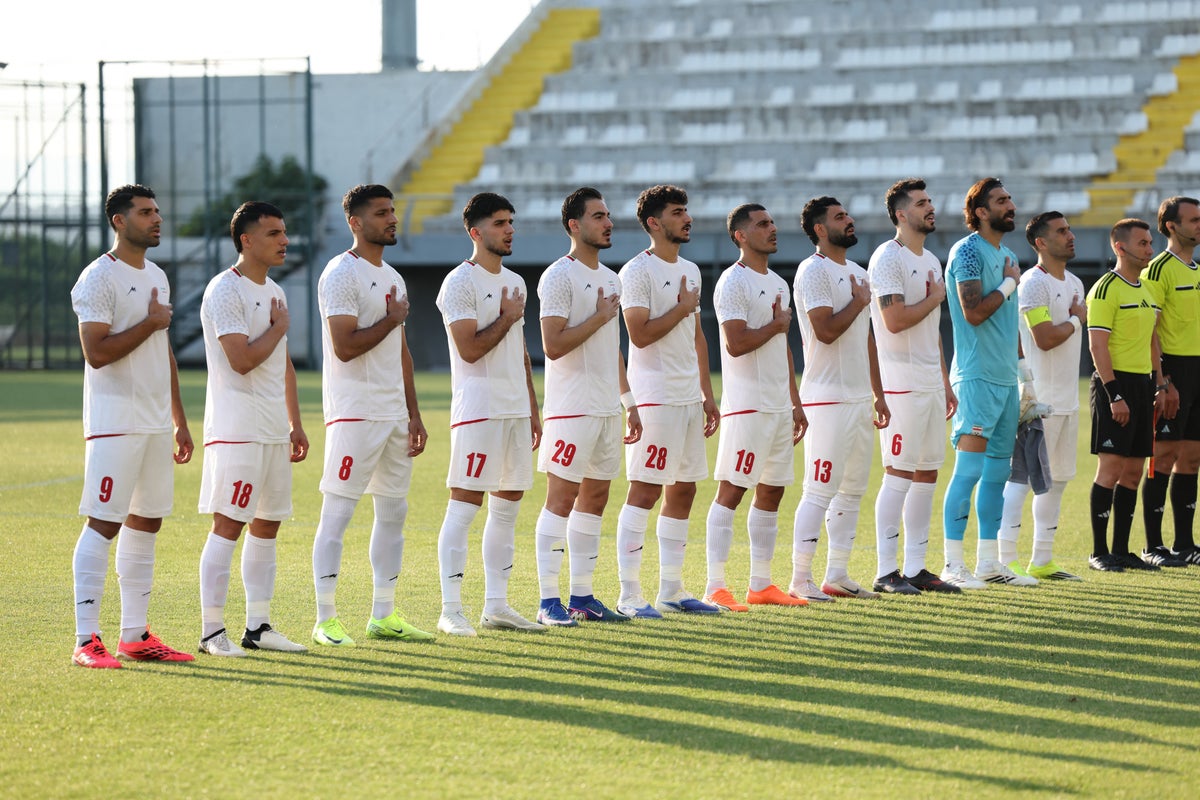
Instead of a seamless transition to the tournament, the Iranian squad has spent weeks isolated in Antalya, Turkey, playing closed-door warm-up matches like their recent fixture against Mali. They are a team in exile before the tournament even kicks off. They fly to Mexico this weekend, forcing them to operate from a border town and travel into the U.S. only when strictly necessary. Per FIFA rules, they won't even cross into American territory until June 14, exactly one day before their opening match against New Zealand in Inglewood, California.
The Heavy Mental Burden on the Pitch
It is easy to look at professional athletes and see millionaires insulated from reality. But Team Melli's players are visibly carrying the weight of their fractured nation. Midfielder Saeid Ezatolahi, a 29-year-old veteran entering his third World Cup, didn't hold back when discussing the mental toll with journalists in Turkey.
"Well, to be honest, it's not easy," Ezatolahi admitted. "We are following the news in our country and the political things, of course, can affect the mind of the players and the people."
The contrast between the veterans and the newcomers is stark. While Ezatolahi relies on his tournament experience to compartmentalize the chaos, younger players like 24-year-old Mohammad Ghorbani are walking straight into a geopolitical firestorm for their World Cup debut. Ghorbani emphasized that the players see their role as a service to a population that has suffered immensely through months of military strikes, economic instability, and fear.
The team's internal consensus is clear: their duty is to fight for their people on the pitch, using football as a rare vehicle for collective national joy. But executing that duty requires an impossible level of mental gymnastics. They must ignore the fact that U.S. President Donald Trump openly questioned whether Iran should even attend the tournament, citing vague concerns over their "life and safety." They must block out the reality of a war back home to focus on defending set-pieces against Belgium and Egypt in Group G.
A Hostile Homecoming in Los Angeles
When Iran finally steps onto the pitch at the Los Angeles Rams' stadium in Inglewood, they won't just be facing New Zealand. They will be walking into one of the most politically charged atmospheres in sports history. Southern California is home to the largest Iranian diaspora outside of Iran.
This crowd isn't a monolith. A massive segment of the local diaspora fiercely opposes the current regime in Tehran. During the 2022 World Cup in Qatar, the team faced intense pressure from both sides—threatened by their own government officials back home to "behave" while facing protests from activists in the stands. In 2026, playing directly in the heart of the diaspora while a literal war is happening, that pressure will be multiplied tenfold.
The players are hyper-aware of this dynamic. They expect a packed stadium, but they also know the crowd’s energy will be volatile, fueled by pain, anger, and complex internal politics.
The Myth of Neutral Ground
FIFA desperately wants this tournament to run smoothly, but the governing body is discovering that you cannot out-schedule a war. The Iranian Football Federation previously requested to move their actual group-stage matches out of the United States entirely, suggesting Mexico as an alternative. FIFA rejected the request, claiming the tournament schedule was set in stone and couldn't be altered.
So, the show goes on. Iran will play under a nominal ceasefire that is violated nearly every week. They will fly into U.S. cities, play under heavy security scrutiny, and immediately retreat to their Mexican base camp.
What can the players actually control in a situation like this? Very little. They can't fix the diplomatic breakdown between Washington and Tehran. They can't alter the travel restrictions or undo the trauma of the conflict affecting their families back home.
The only actionable step left for Team Melli is to find cohesion in isolation. By blocking out the noise during their closed-door sessions and relying entirely on internal leadership, the squad is trying to transform from a collection of stressed individuals into a unified front. If you are watching Group G this month, don't just look at the tactics or the scorelines. Watch the faces of the Iranian players during the anthems. You'll be looking at athletes who are carrying an entire geopolitical crisis on their shoulders.
The complex intersection of international sport and global conflict is analyzed in depth by experts looking at how the co-hosts are managing these unprecedented security challenges. For a breakdown of the growing diplomatic drama between the U.S. and Mexico over hosting duties, check out this US vs Mexico World Cup political analysis. This video provides crucial context on how the tournament is turning into a political battlefield before the first whistle blows.