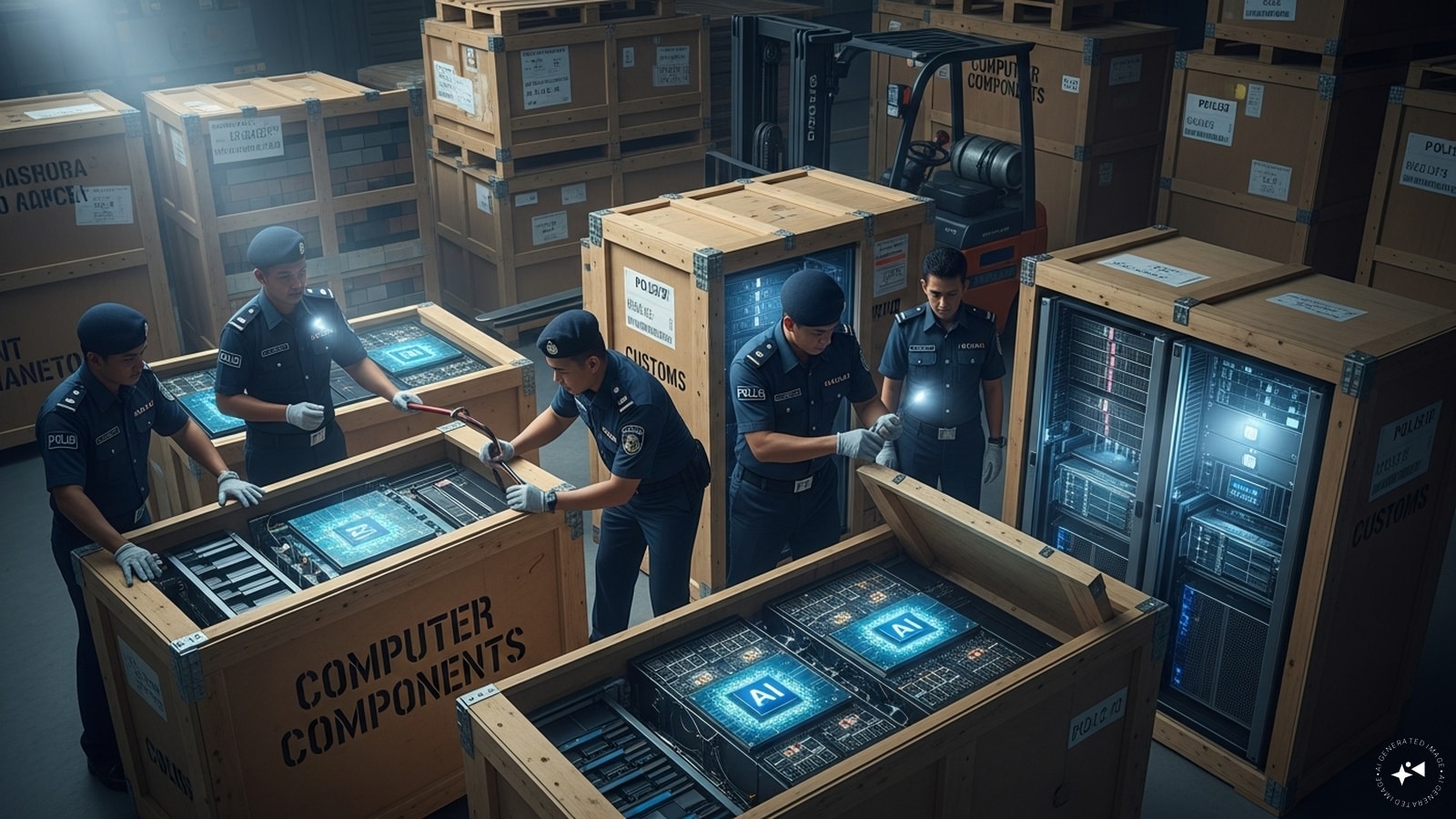
The air inside the free trade zone at Kuala Lumpur International Airport smells faintly of jet fuel, damp asphalt, and the underlying static hum of global logistics. It is a transit world. A place where things exist without officially being anywhere. On June 5, 2026, a manifest arrived listing seventy-two server units, categorized under the most mundane label imaginable: "computer components."
To an average observer, they were just heavy steel boxes destined for another routine leg of an Asian transit route. But these were not ordinary servers.
When Malaysian customs officers broke the seals and peeled back the casing, they did not find standard enterprise hard drives or budget motherboards. They found a high-density, silicon goldmine. Packed tightly inside those seventy-two servers were advanced artificial intelligence chips valued at 52.9 million ringgit—roughly 13 million US dollars.
Nobody tries to smuggle ordinary computer parts using sophisticated international shell games. You only run those risks when you are carrying the fire of the modern world. These specific chips represent the rarest currency on earth: the hyper-scarce computational muscle required to train advanced AI models.
To understand why 13 million dollars of silicon was sitting in a humid Malaysian warehouse under a fake name, you have to look past the hardware. You have to look at the invisible lines being drawn across the globe.
The New Contraband
For decades, customs busts at major international hubs followed a predictable script. Narcotics hidden in secret compartments. Illicit wildlife. Crates of counterfeit luxury goods.
Now, the contraband of choice is computing power.
Consider a hypothetical logistics manager we will call Chen. He does not work with cartel bosses or international arms dealers. He wears a tailored suit and coordinates supply chains from a high-rise office. But the pressure he faces is immense. His clients do not want money; they want computing power. They need it because, in the global tech race, running out of advanced silicon means immediate obsolescence.
When the United States choked off the supply of high-performance semiconductor shipments to specific Asian markets, a massive, pressurized vacuum formed. On one side of the line is a desperate demand for advanced AI capabilities. On the other side is a strict blockade of export controls.
Malaysia, sitting squarely at the geographic crossroads of global shipping, became the accidental fault line. In 2025, under intense pressure from Washington, Malaysia implemented tight export controls on US-origin high-performance chips. The goal was simple: close the backdoors.
But water always finds a crack.
The syndicate behind the 72 servers tried to use the free trade zone as an invisibility cloak. By logging the cargo as a transhipment—goods passing through a country without legally entering its domestic market—they bypassed standard domestic declarations. The paperwork claimed the destination was a neutral neighboring country. The reality, investigators believe, was a highly coordinated detour designed to scrub the origin of the chips and funnel them directly into restricted territory.
It is a high-stakes shell game where a single successful shipment can net millions in black-market premiums.
Liquid and Silicon
The sheer audacity of the operation became even clearer as customs officers dug deeper into the airport's holding facilities during the wider crackdown. In a separate, parallel seizure that feels like dark poetry, officials discovered six boxes containing nearly five thousand vape liquid cartridges hidden inside empty CPU casings.
The liquid was laced with methamphetamine.
The contrast is striking. In one hangar, old-world criminal networks were hiding street drugs inside the hollow shells of technology. In the adjacent hangar, a new breed of syndicate was hiding technology inside the open sightlines of legitimate business. The methods are converging, but the stakes of the silicon trade are infinitely higher than the narcotics trade. A kilo of illicit substances disrupts a neighborhood; a container of restricted AI chips shifts the balance of geopolitical power.
We often talk about artificial intelligence as a cloud. We speak of it as an ethereal, digital spirit that exists everywhere and nowhere at once. We talk about algorithms as if they are born from pure thought.
This bust is a violent reminder of the heavy, physical reality of the digital age.
AI is not ethereal. It is heavy. It requires copper, gold, rare earth elements, and billions of transistors etched onto silicon wafers using ultra-precise ultraviolet light. It requires massive amounts of electricity and intense cooling infrastructure. If you do not have the physical hardware, the algorithm is just a dead lines of code on a page.
That reality is why people are now forging shipping manifests and risking twenty-year prison sentences for boxes of server racks.
The Broken Promise of the Support Line
There is a profound irony at the center of this modern smuggling trade. Let us assume the shipment had cleared Kuala Lumpur undetected. Let us assume it arrived at its final, illicit destination, where engineers eagerly unboxed the servers and bolted them into a hidden data center.
The moment they flipped the switch, they would face an invisible wall.
Major chip manufacturers like Nvidia do not just sell a piece of hardware and walk away. Modern AI clusters are temperamental, fragile ecosystems. They require constant firmware updates, proprietary software optimizations, and highly specialized, ongoing maintenance. When a complex cluster fails—and they always do—engineers rely heavily on direct manufacturer support to diagnose the failure.
For smuggled chips, that support line is dead.
The manufacturers explicitly state that diverted, black-market hardware receives zero service, zero updates, and zero corporate support. The buyers are essentially purchasing a Ferrari but ensuring they can never take it to a mechanic, buy replacement parts, or update the engine software. They are running multi-million-dollar operations on hardware that is completely isolated from the mothership.
Yet, they still pay the premium. They still run the risk.
That tells us everything we need to know about the desperation of the current moment. The hunger for computational capacity is so intense that organizations are willing to build their digital futures on crippled, unsupportable foundations. They would rather have a blind, deaf giant than no giant at all.
The seventy-two servers now sit in an evidence locker, silent and dark. Their fans are still. Their circuits carry no current. Outside the warehouse, the cargo planes continue to land and take off in the tropical heat, carrying thousands of identical steel boxes across the world.
The systems designed to track global commerce look for weights, dimensions, and standard tariff codes. They are built for a world of physical commodities. But the global economy is now driven by something that cannot be weighed on a scale or measured by customs agents with clipboards.
The customs officers at Kuala Lumpur International Airport did not just seize a collection of computer components on June 5. They intercepted a shipment of raw potential, turning a multi-million-dollar vision of artificial intelligence back into what it fundamentally is: just a pile of cold, quiet metal.